Artificial intelligence has rewritten the way people create, revise, and publish written content across all scenarios of modern communication. From students rushing to finish their assignments to enterprises drafting copy for their websites, anyone who uses AI-powered writing tools can save a massive amount of time. The content creation process that used to take several hours to sort out independently can now have its framework built quickly by AI, freeing creators from the most labor-intensive task of drafting the first version.
However, the growing popularity of generative AI has also spawned an unavoidable demand: there must be tools to help people distinguish whether a piece of writing carries the unique traces of human authorship, or aligns with the common patterns of AI-generated content. After all, whether it is a teacher grading students’ assignments, or a webmaster responsible for a site’s readers, they must first clarify whether the content in hand is original thought, or a standardized output pieced together by AI.
Today’s AI checker free tools fill this gap, and among them, free, easy-to-use AI checkers have become the first choice for all types of users. These tools allow authors, students, editors, and webmasters to run an analysis before publishing or submitting their content, instead of guessing how the content was written. They can obtain a set of automated assessment results generated based on linguistic and statistical patterns. Unlike ordinary people who can only guess by « whether it reads like a robot wrote it », these systems dissect the underlying patterns of the text to deliver a clear, data-backed judgment of the text’s origin. Even first-time users can quickly grasp what potential problems their content might have.
What Is AI Content Checker?
An AI Content Checker is a type of software tool used to examine written content and assess whether it carries the most common features of AI-generated text. The content produced by today’s large language models often has uniform sentence structures, entirely predictable word choices, and an overly rigid writing style, which is completely different from the natural fluctuations in human writing. Humans may write short, impactful sentences when emotionally charged, or lay out long paragraphs to explain complex ideas, and even throw out a rhetorical question to readers. These flexible changes are rarely found naturally in freshly generated AI-generated content.
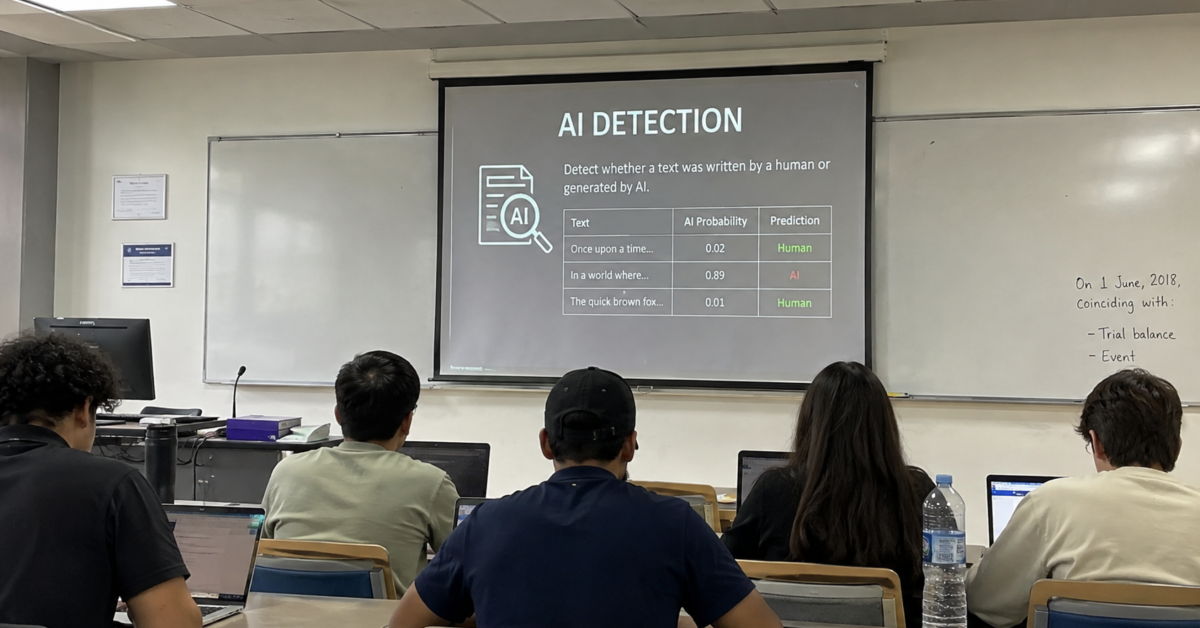
AI detection systems dissect these features to output a probability or confidence score. Some tools can even mark which sentences and paragraphs have a far higher probability of being AI-generated than human-written.
It is important to clarify one point: an AI Checker cannot be 100% certain who wrote any given sentence. It only analyzes patterns in the text to make a prediction, so its results can only ever be used as a reference, not as conclusive evidence of a text’s origin. Even if a passage is marked with a 90% probability of being AI-generated, it could still be original content polished over several days by a human author who habitually writes in a structured style.
Why Are AI Checkers Becoming Important?
The explosive growth of generative AI has brought new troubles to nearly all content creators. Schools require students to complete original, independent assignments, while publishers and enterprises demand content with authentic, unique editorial styles. These core requirements have become bottom lines that require effort to uphold, at a time when anyone can call on AI to draft a first version with ease.
For webmasters, the weight of originality and quality is even greater. If a piece of content reads repetitive, vague, and full of generic phrases, even if all the facts are correct, the reader’s experience will be very poor. Click on a local restaurant review article that is filled with generic descriptions like « this shop has a beautiful environment and thoughtful service », with no specific personal experience details, and no one will want to keep reading, let alone share it or revisit the website. An AI Checker can help authors mark which sections need further polishing and adjustment, replacing generic platitudes with their own real feelings.
For students, these tools can also encourage them to put care into revising their drafts. Instead of submitting the first draft written by AI directly, students can re-read their content, add their own unique ideas, verify core facts, and ultimately produce a work that truly reflects their own understanding of the topic. Even if they used AI to research materials and build a framework, if the final content is filled with their own thoughts, the assignment remains an original piece that belongs only to them.
How Does AI Detection Work?
Different AI detectors use different underlying technologies, but the vast majority focus their analysis on linguistic features and statistical patterns. One core concept supporting this logic is perplexity, which measures how predictable the word order in a text is. The content written by AI often has extremely predictable word choices, because language models select each next word based on calculated statistical probabilities. For example, if the preceding text is « today’s weather is really », AI will most likely add « good », rather than a human’s spontaneous addition of « terrible, I forgot my umbrella and got caught in the rain again ». This unorthodox combination is difficult for AI to produce naturally.
Another core concept is burstiness, which describes the range of variation in sentence length and structure within a text. When humans write, they naturally switch between snappy short sentences, longer explanatory paragraphs, rhetorical questions, and diverse stylistic choices. AI-written content often has an overly rigid structure, consisting entirely of declarative sentences of similar length from start to finish, reading like an official press release, lacking the spontaneity of natural human speech.
Many modern detection systems combine these two core signals with precise single-sentence analysis, customized machine learning models, and cross-reference them with known patterns extracted from dozens of Different AI systems to make comprehensive judgments, minimizing the probability of misclassification as much as possible.
Who Can Benefit From AI Checker?
AI detection tools can deliver value to a wide range of users.
Students and teachers can integrate it into their full academic integrity review process, but they must never rely solely on the detector’s score to determine that academic misconduct has occurred. Many medical students writing professional course papers inevitably use a large number of standardized medical terminology, resulting in content with very high predictability that is easily mislabeled by AI Checkers. In such cases, teachers need to combine their usual understanding of the student to make a manual judgment, rather than making a sweeping condemnation.
Bloggers and content creators can run their drafts through an AI Checker to mark sections that are too generic or repetitive, using that opportunity to revise the content for clarity and refine a more distinct personal style. Replacing forgettable generic phrases with unique quips or insights that only they would write allows them to gradually build a base of loyal readers who follow their updates exclusively.
Enterprises and publishers can also use these detection tools when reviewing content submitted by a large number of different creators. If they can first flag potentially problematic sections before assigning them for manual review, it becomes much easier to maintain consistent high editorial standards. Instead of editors sifting through dozens of first drafts to find issues like searching for a needle in a haystack, they can spend more time refining high-quality content.
AI Detection Is Not the Same as Plagiarism Detection
These two concepts are often confused by new users, but their uses in quality control are completely distinct.
Ordinary plagiarism detection tools compare submitted content against existing content stored in large databases or published online to find overlaps. Put simply, they check whether you have copied content written by someone else; even if you only copied a single paragraph, if it exists in the database, it will be caught. An AI Checker, by contrast, dissects the writing features of the text to assess whether it resembles AI-generated content. Even if the content has never appeared online before and is one-of-a-kind in the world, it can still run an analysis.
Therefore, a piece of content can be 100% original but still receive a high AI-generated score. Conversely, if a human-written content copies someone else’s work, it will not necessarily trigger an alert from an AI Checker. The plagiarized content was written by another human, and its linguistic features align with the patterns of human writing, so it will not be flagged by an AI Checker. That is when plagiarism detection tools are needed. Choosing the right tool for the problem you need to solve is the key.
Why Manual Review Still Cannot Be Skipped?
No automated AI detector can achieve 100% accuracy. Human-written content can sometimes also have very high predictability, especially when the topic requires formal, professional, or standardized language, leaving little room for stylistic expression, making it prone to misclassification. Similarly, if AI-generated content is heavily revised, with every sentence’s word order adjusted and generic terms replaced with unique personal phrasing, automated systems can barely identify it correctly, as they can only compare against the patterns of unmodified native AI content.
For this reason, AI scores can only ever be a small part of a comprehensive review process. Authors must still check their content for factual accuracy, originality, readability, grammatical correctness, and appropriate tone, and confirm whether the text can deliver truly useful, meaningful information to the target audience. Even if AI gives your content a 100% human-original score, if the facts inside are wrong, the content is still unqualified and cannot be published.
The most reliable, prudent way to use these tools is to treat AI detection technology as an additional quality control step, and never rely solely on a percentage score to decide whether a piece of content can be published or submitted. Machines can only help you scan for surface-level problems; the only person who can truly take responsibility for the content is you, the author.
A Practical Way to Review Content
A simple, repeatable workflow can make AI detection work better for any user. First, organize all the complete content you need to review; do not run a half-finished draft through detection, as the results from incomplete content have no reference value. Next, input the content into an AI detection tool and review the overall results generated. If some sentences are marked as high-risk, read those sections carefully, and do not rewrite all of your content immediately just to chase a specific score. Many flagged sections only happen to align with AI writing patterns but are otherwise high-quality and do not need unnecessary revisions.
Look for repetitive phrasing, filler text that only serves to pad the word count, awkward transitions, and vague statements that fail to convey specific information. Then revise the content to fix these quality gaps, rather than revising solely to manipulate the detector’s final score. What is the point of earning a perfect human score if you split coherent sentences into an unreadable mess just to fool the detector?
Articles written with this method will be more natural and engaging for readers, and keep the core focus on readers’ needs and experiences, rather than meeting the requirements of an automated tool. Readers click on your content to find useful information, not to help you hit a target score from an AI Checker. Putting readers first is always the right choice.
Final Thoughts
In the foreseeable future, AI writing technology will most likely remain a core part of modern content creation. As more people use it, AI detection tools can add a valuable layer of review to written content, helping creators understand how their work will be interpreted by audiences and various institutions. Even if you are just an ordinary student who used AI to research materials, running your work through a free detector in advance to revise it to sound more like your own writing can help you avoid many unnecessary misunderstandings.